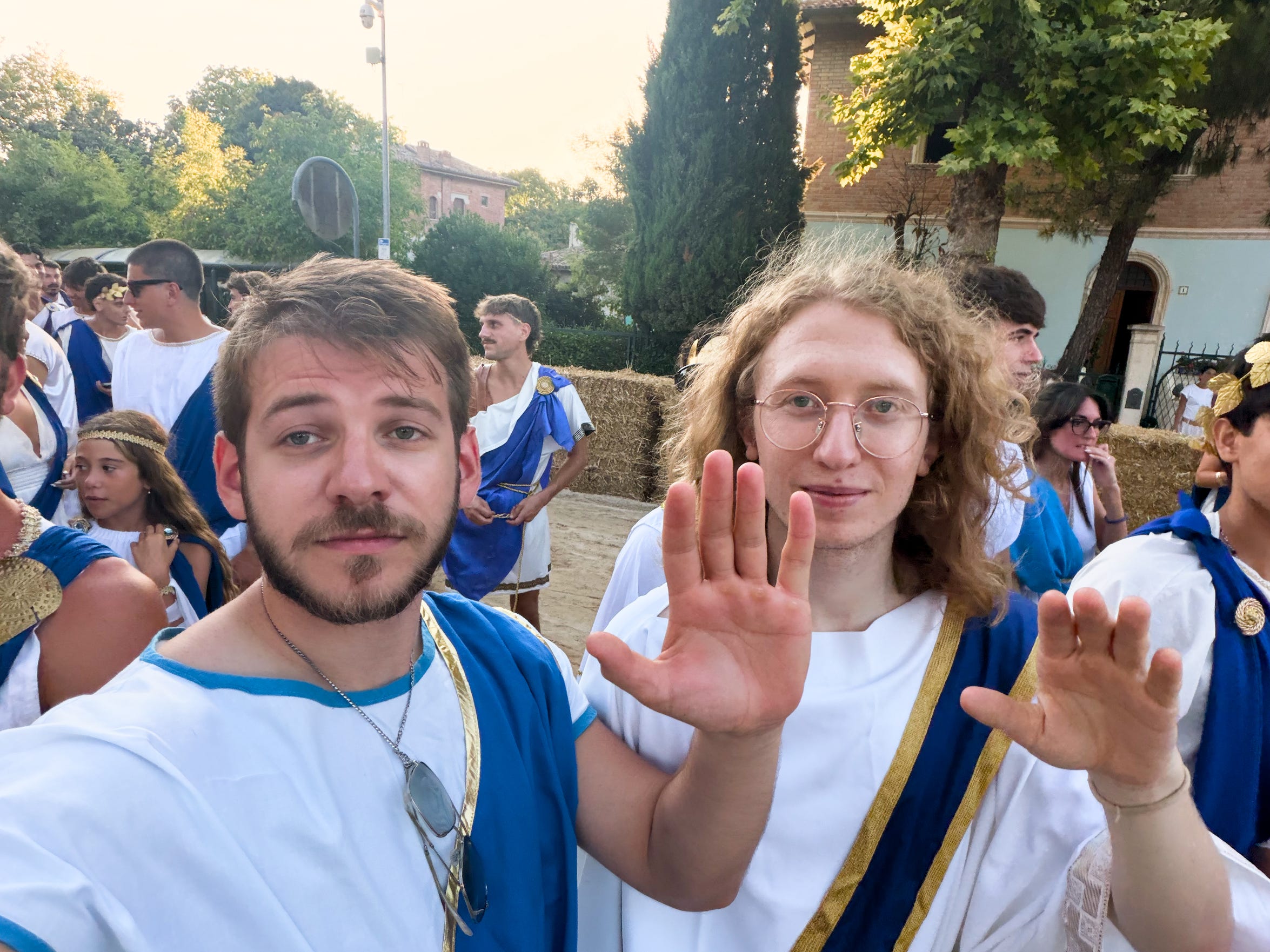
A few days ago, dressed as a Roman on top of a fifteenth-century military fortress, I found myself staring at a wooden fence and wondering whether its designer had made it high enough to stop a drunk legionnaire from falling to his death.
This was not how I had planned to spend my last forty-eight hours in Italy.
I had spent the previous week disappearing into the mountains of Garfagnana, hiking, mountain biking, smoking Tuscan cigars and eating slightly more than all that exercise could plausibly excuse.
I was only back in my hometown, Fano, for two days before flying home to Portugal.
Then, somewhere on the bus back to Fano, I discovered that I would arrive on the exact day of the twenty-second edition of La Fano dei Cesari, the biggest event in town after Carnival and BrodettoFest, a four-day celebration during which thousands of people gather to argue about the correct way to boil the entire Adriatic food chain in tomato sauce.
BrodettoFest celebrates our ability to turn fish leftovers into civic identity.
La Fano dei Cesari celebrates our equally flexible relationship with history: for one day, the entire town becomes ancient Rome, based mostly on costumes, alcohol and whatever people remember from Gladiator.
Each neighbourhood gets its own colour. People put on tunics and armour, build chariots, fill them with salami, cheese, fruit and, obviously, barrels of wine.
A lot of wine.
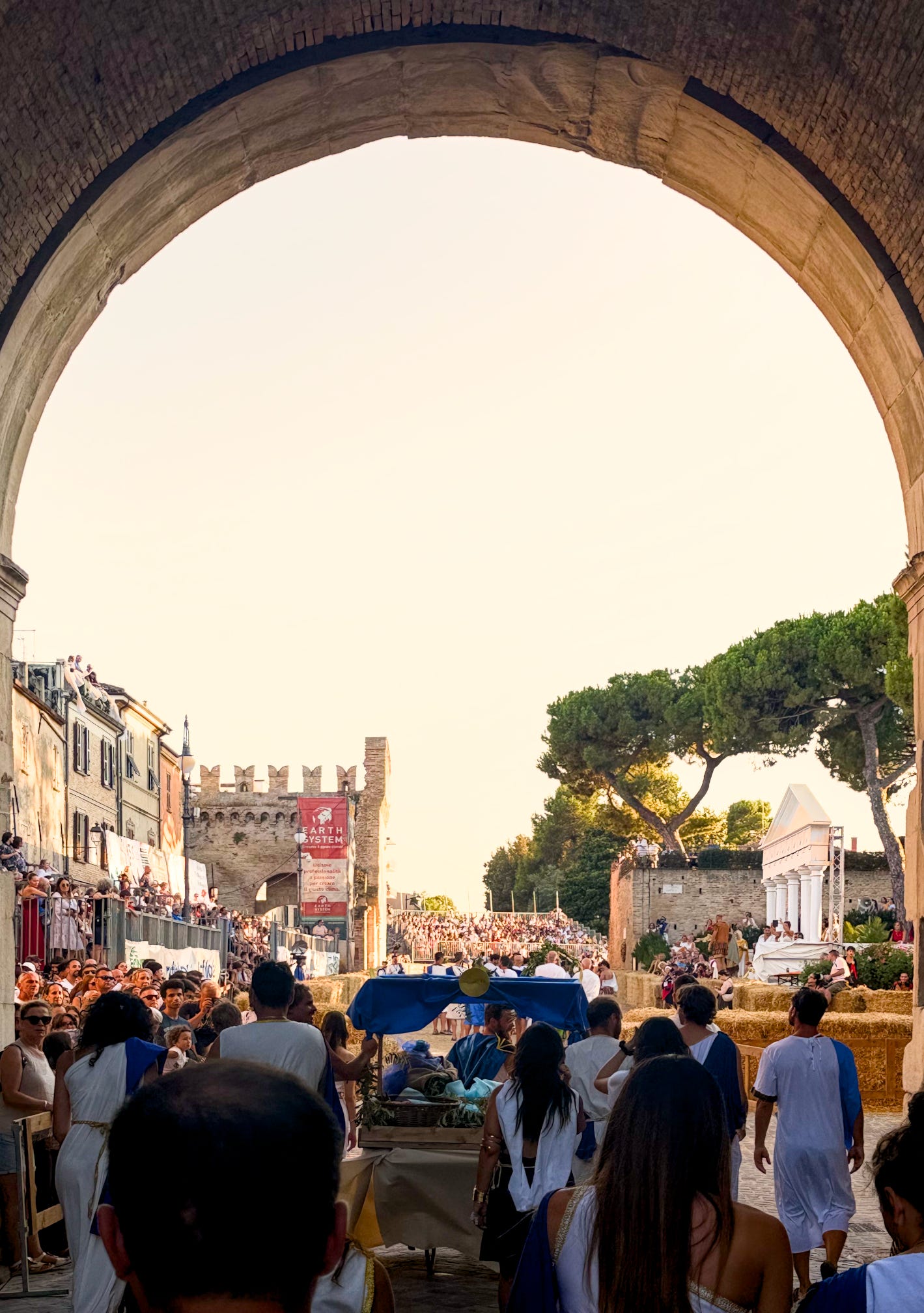
They then march through the historic centre until they reach the Pincio, where the fortress rises above the city. When I was younger, the area was mostly known as a convenient place to buy weed. Then it was cleaned up, filled with lights, and turned into something people could proudly bring their children to.
Progress.
Anyway, standing on top of that fortress, surrounded by several hundred Romans and overlooking an arena where horses would soon drag chariots around in circles, I had two revelations.
The first came while looking at the fence separating me from a very stupid death.
The second came while looking, possibly for slightly too long, at the beautiful Roman women around me.
The two revelations seemed unrelated.
One involved public infrastructure. The other involved lust.
It took me a while to understand that they were pointing at the same thing.
The fence came first.
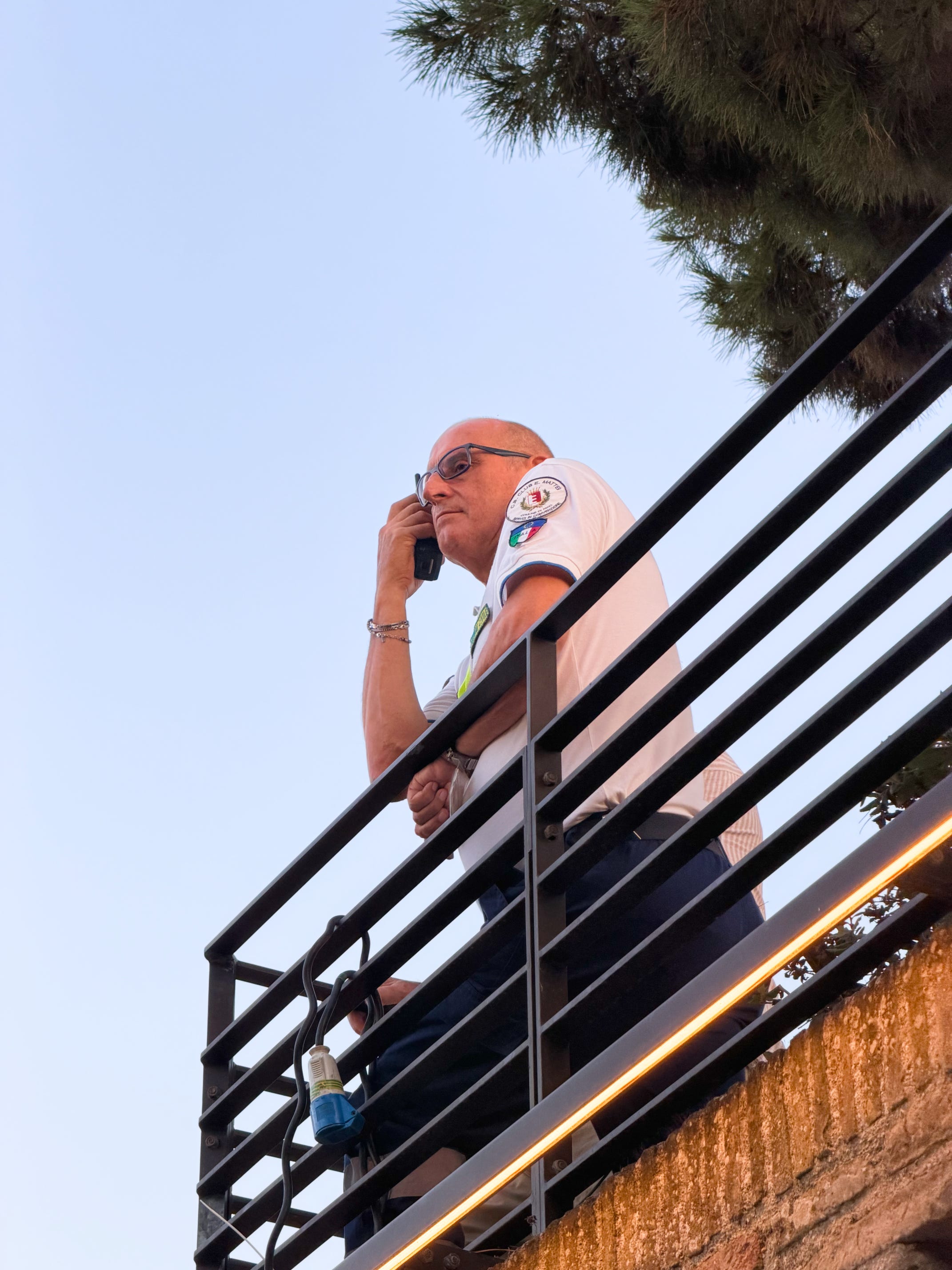
Someone had spent years earning a degree, passing a state exam and becoming licensed to work on public projects. Then came the tender, the specifications, the meetings, the regulations and the liability. Finally, after all that, the fence.
Days spent inside AutoCAD. Measuring angles. Comparing materials. Calculating loads. Moving lines around a screen so that drunk Romans like me could lean over the edge of a fortress without becoming a municipal incident.
Then someone else had come to the fortress and built it.
The same fence. Two completely different relationships with reality.
The designer had worked through representations: drawings, measurements, regulations, numbers. The builder had touched the stone, carried the materials, fought against gravity, felt the sun, probably sworn several times and gone home with dust on his clothes.
This was unfair to the designer, whose work was real, necessary and probably much harder than I understood. Without those lines, there would have been no fence.
But one person had imagined the object.
The other had made the lines heavy.
Some jobs place you directly inside the physical world. Others happen one layer removed from it.
At least, that was how it felt to me. And I had spent most of the previous few years living in that extra layer.
Then I looked at the girls around me.
They were beautiful. Not in the polished, carefully selected way people look on dating apps. They were dressed as Romans, drinking wine, laughing with people they had probably known since primary school.
Fano is small enough that everybody knows everybody, or at least knows who everybody has slept with.
I had lived there for eighteen years before leaving for Milan, yet I seemed to know almost no one.
I had come to the festival with two friends.
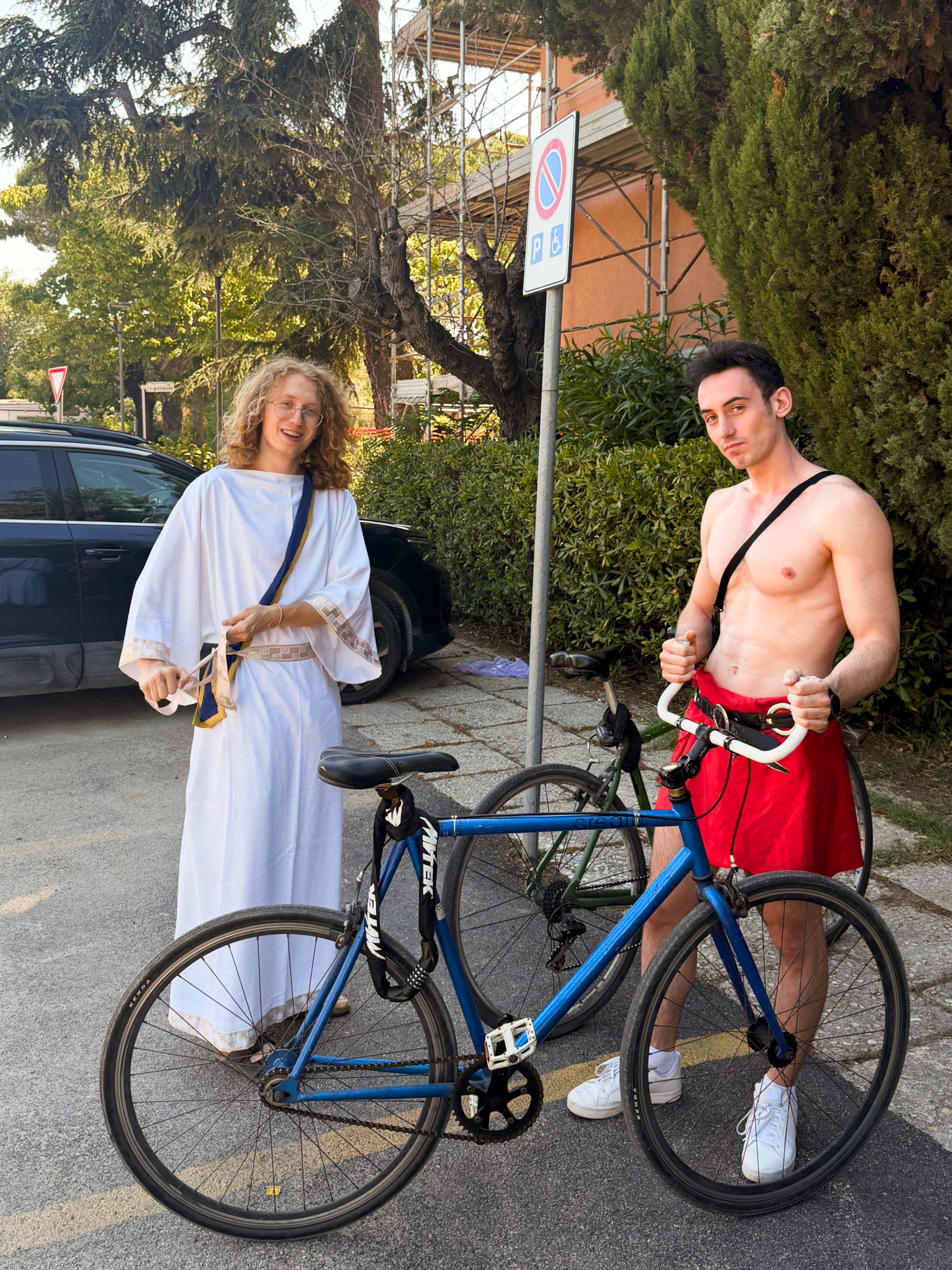
The first was Lorenzo, probably my best friend, who looked like Roman Jesus. His long, curly hair blew in the wind as he wandered around in a tunic with the calm authority of someone who had already forgiven the Empire.
The second was Umberto, a close friend of Lorenzo’s who, until recently, had been more of an acquaintance to me. We had started seeing each other more often after discovering, outside a pub after a few drinks, that we both practised Brazilian jiu-jitsu.
The obvious adult response was to strip down to our boxers in Rocca Malatestiana at one in the morning and try to choke each other unconscious.
At the festival, Umberto was wearing no shirt and a very short red Roman skirt. This created a political problem because our neighbourhood was blue.
Out of the blue (see the pun?), my mother found a piece of rope, tied his wrists and declared him the captured slave of our division. This somehow made the red acceptable
Umberto is tall, well-groomed and offensively jacked. At least eight abdominal muscles were visible, which is surprising considering the amount of wine and nicotine pouches I have watched this man consume.
I would be lying if I said I wasn’t jealous of the attention he was getting. I tried to treat the jealousy as field research.
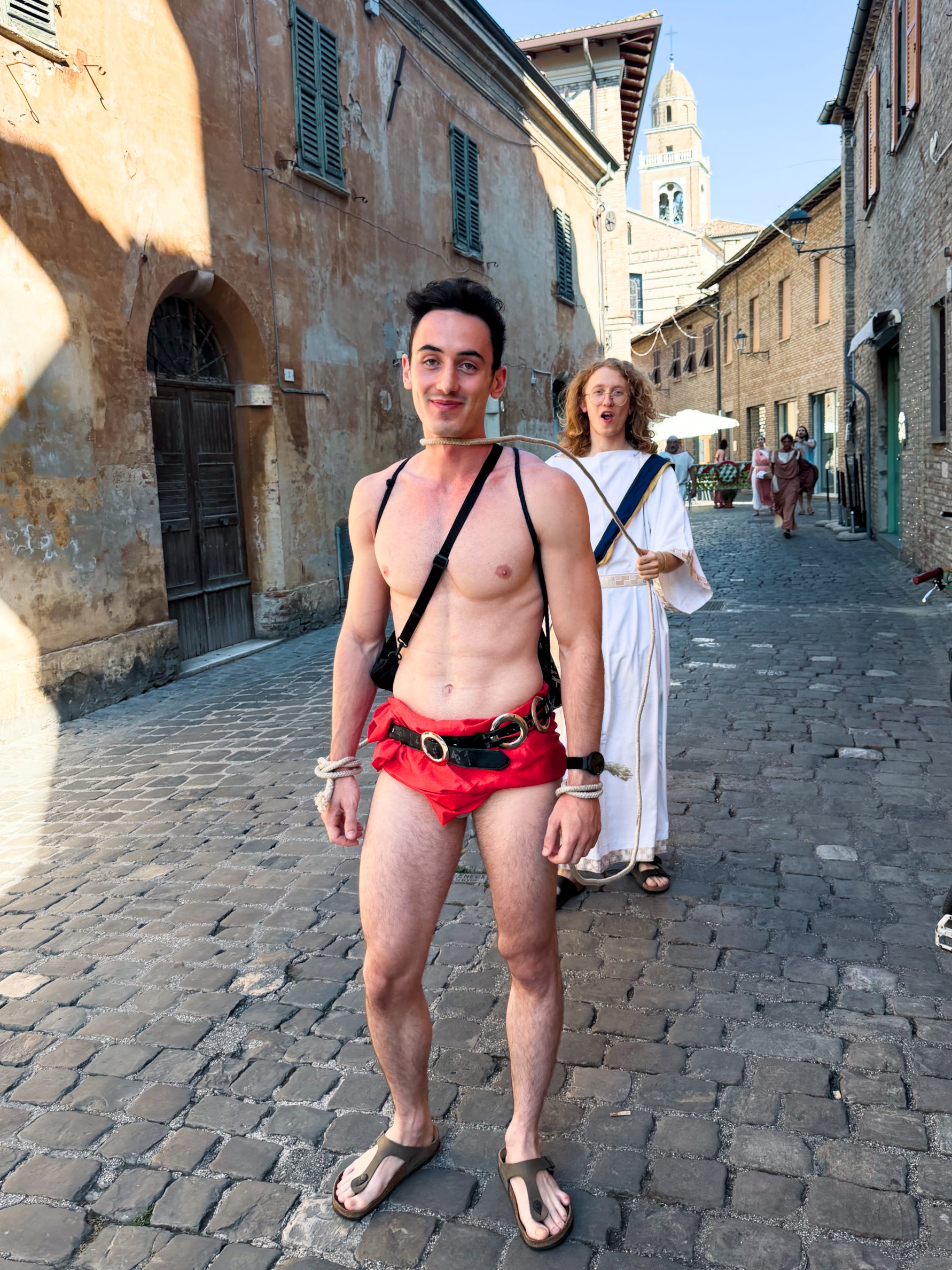
I could watch the women’s eyes follow him as he walked past. First the abs, then the face, then the verdict, all performed with enough nonchalance to preserve plausible deniability.
Umberto would notice, trace the gaze back to its source and simply walk over. He did not need an opening line. He would ask whatever stupid question entered his head.
So when does the march begin?
How do the chariots work?
How much do I have to pay for a slice of salami?
The questions did not matter. He was already there.
At one point, a goth-looking girl with perfect makeup watched him approach, narrowed her eyes and slowly bit one of her nails. It was so sexually explicit in its restraint that I had seen porn films begin with less.
It was humbling.
A few days earlier, I had asked ChatGPT how many Italians my age had as much money as I had in the bank.
It told me, with the statistical confidence of a machine that would never be held accountable, that the number was probably somewhere between 0.05 and 0.1 percent.
Not a single person on that fortress seemed particularly impressed.
Which was reasonable.
Money is useful even when nobody can see it. It buys freedom, time and the possibility of leaving situations you no longer want to be in.
But money becomes visible only through what it changes in your life.
Mine had mostly turned into travel, companies, bank accounts, tax residencies and a suspiciously detailed understanding of email deliverability.
It had given me options. It had not given me a body I felt completely at home in, a place inside the city’s social fabric or the confidence to walk across a square and speak to someone I found attractive.
The attention Umberto was getting had nothing to do with money.
He was simply there.
In his body. In the city. Among people who could see him.
I had spent the years when adult friendships and social circles were taking shape jumping from place to place, building businesses but few roots. I had never learned how to dress particularly well. My Italian had become littered with English words. I had let my hair and beard grow slightly feral, and I had returned from Garfagnana carrying several additional kilos of Tuscan cuisine.
Whatever I had accumulated existed mostly in accounts and dashboards.
That was the second revelation, or perhaps the same revelation seen from the other side.
I knew how to build an n8n automation, but I did not know how to dance.
I knew how to open companies, bank accounts and residencies in different countries, but I could barely cook myself a proper dinner.
I knew how to get around Google’s filters and deliver emails into thousands of inboxes, but walking across a square and introducing myself to a woman still seemed more complicated.
Sure, I had been on plenty of successful dates through dating apps.
But the apps were part of the same problem.
They allowed me to search, filter, match and message. They had turned intimacy into another funnel that a marketer like me could optimise.
Perhaps that was why I had been so comfortable using them.
They were outside life.
For years, I had become increasingly competent at things that protected me from the embarrassment of being physically present.
I had learned how to make money, move countries, generate leads and automate work.
All useful skills. None of them could cook for me, dance for me, build friendships for me or walk across that square and win over the beautiful goth girl on my behalf.
Some tastes, unfortunately, survive every attempt at optimisation.
Since that night, which was literally last week, I have been trying to force myself further inside life.
Not further inside my head. I have lived there long enough.
Inside life.
Get your hands dirty. Walk up to people before you have time to optimise the interaction. Learn things with no obvious return except a tired body, a new memory, a bruise or a story.
Ride a motorcycle somewhere. Sneak into a conference. Learn how to dress and build a wardrobe that actually feels like yours. Put your face and personality on camera and survive being seen.
Learn to fly a plane. Go scuba diving. Learn another language.
Learn Portuguese, for fuck’s sake. I have lived in Portugal for two years and still cannot speak it properly.
Learn all the apparently useless things with zero measurable ROI that remind you that you have a body, a soul and only one chance to use both of them.
I want the same from my work.
I no longer want a job that requires me to step outside life in order to earn a living.
I want work that grows out of living: going places, meeting people, attempting things badly, paying attention and coming back with something worth telling.
I want to make a living out of feeling alive.
Not watching life through a dashboard.
Not filtering it through an app.
Not moving representations of it around a screen.
Actually being there.
And you, reading this: do you feel like you’re living inside or outside your life?
The good news is that we can always step back in.